A Landmark Deal for American Industry
On Wednesday, President Donald Trump announced a major breakthrough in his ongoing campaign to bring global manufacturing back to American soil: Apple will invest $100 billion into U.S. manufacturing over the next four years.
The move, which comes amid rising tensions between the U.S. and key trade partners like China and India, positions Apple at the forefront of a strategic shift in the global tech supply chain.
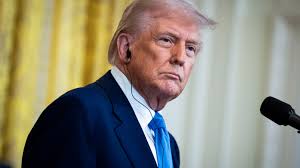
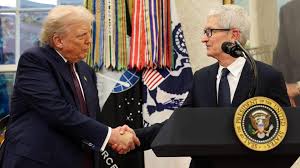
“Companies like Apple, they’re coming home,” Trump declared during a ceremony at the White House, where Apple CEO Tim Cook presented him with a U.S.-made 24-karat gold souvenir.
The announcement marks a $100 billion increase from Apple’s previously pledged $500 billion U.S. investment — now totaling $600 billion — in what may be the company’s most significant reshoring effort to date.
The Trump Effect – Tariffs, Pressure, and Strategic Response
Tariffs as a Catalyst for Change
Trump’s aggressive trade policies have played a major role in Apple’s decision. The president’s threat to impose punishing tariffs on imports from China and India has forced multinational corporations to rethink long-standing offshore manufacturing strategies.
Apple, heavily reliant on a complex international supply chain, found itself at risk. CEO Tim Cook revealed earlier this year that Trump’s tariffs could cost Apple up to $900 million in a single fiscal quarter.
India, a country Apple has looked to for diversifying production outside China, also fell into Trump’s crosshairs. On the same day as Apple’s announcement, the administration doubled tariffs on Indian goods to 50%, citing the country’s use of Russian oil.
“I don’t want you building in India,” Trump reportedly told Cook in a previous conversation, further signaling his push for American-made iPhones.
Apple’s $100 Billion Investment Strategy
Reinforcing the Domestic Supply Chain
According to Apple, the new round of investment will focus on expanding partnerships with at least 10 U.S.-based companies that produce components for Apple products. Among them is MP Materials, a rare earths company that recently signed a $500 million deal with Apple to ramp up domestic production of vital components used in iPhones.
MP Materials operates the only rare earth mine in the U.S. and is now set to expand its Texas factory to use recycled materials to produce vibration magnets for Apple devices — a major win for both the environment and American industry.
What’s Made in America (and What’s Not… Yet)
Tim Cook emphasized during the announcement that several key iPhone components are already U.S.-made, including:
-
The glass display
-
Face ID sensors
-
Semiconductors, including chips
Apple currently sources roughly 19 billion chips annually from the U.S., and Cook confirmed that this figure is expected to grow significantly under the new investment plan.
However, final assembly of iPhones will remain overseas “for a while”, according to Cook — a pragmatic decision given labor cost differentials and the complexity of shifting large-scale electronics assembly operations.
Jobs, AI, and the Bigger Picture
20,000 New Jobs in the Pipeline
As part of the commitment, Apple said it will directly hire 20,000 workers in the United States over the next four years. These roles are expected to span across hardware manufacturing, engineering, logistics, and operations.
This is consistent with Apple’s trend of expanding its domestic footprint. In recent years, the company has opened new campuses, data centers, and R&D facilities in cities across Texas, North Carolina, and California.
AI Investment Still Lags Behind Rivals
Despite the optimism around its manufacturing strategy, Apple continues to face criticism for lagging behind competitors in the artificial intelligence race. In 2025 alone, tech giants have poured over $155 billion into AI, with projections suggesting hundreds of billions more in the years ahead.
While Apple’s recent earnings report showed strong iPhone sales and a 5% stock jump following the manufacturing announcement, analysts remain cautious about its position in emerging technologies.
A Win-Win or a Strategic Compromise?
Apple’s $100 billion commitment is undoubtedly a win for Trump’s economic agenda and a symbolic victory in his effort to revitalize American manufacturing.
However, it also represents a strategic compromise by Apple. Facing rising tariffs, volatile geopolitics, and investor anxiety, the company has chosen to invest in predictability and political favor rather than risk supply chain disruption.
Tim Cook’s approach appears to be one of pragmatic diplomacy — signaling alignment with the White House while preserving core business functions overseas where feasible.
Made in America, or Just Assembled Here?
Trump’s trade war and tough-on-globalism stance has prompted one of the largest domestic investments in Apple’s history. Whether this signals a true reshoring of iPhone production or remains a symbolic gesture remains to be seen.
For now, the company seems focused on balancing global efficiency with political compliance — a delicate dance that tech CEOs may need to master as the rules of global trade continue to shift under populist economic policies.
One thing is clear: as long as Trump’s tariffs loom, Apple’s supply chain strategy will increasingly favor Made in America — at least in part.