A Revolutionary Law Now Under Relentless Attack
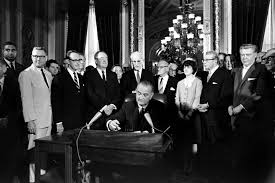
Sixty years ago, in the wake of brutal racial violence and mass protests, the United States passed the Voting Rights Act of 1965 — a cornerstone of civil rights legislation meant to protect Black Americans’ access to the ballot. It was a direct response to centuries of disenfranchisement, codified discrimination, and political manipulation designed to silence communities of color.
Today, in 2025, the law remains under siege. Court decisions, legislative gridlock, and new redistricting efforts reveal that the fight over the right to vote — and who gets to wield political power — is far from over.
History Repeats: The Roots of the Voting Rights Act
The VRA was born in blood. Civil rights demonstrations, particularly the infamous 1965 “Bloody Sunday” in Selma, Alabama, broadcast the violent suppression of Black Americans seeking to register to vote. Americans watched in horror as peaceful protesters, including the future Congressman John Lewis, were beaten on national television.
Congress responded by enacting a law that would permanently reshape American democracy. It banned literacy tests and other discriminatory practices, required jurisdictions with a history of voter suppression to obtain federal approval (pre-clearance) for election changes, and allowed for legal challenges against unfair redistricting.
The Shelby Decision: A Turning Point in Voting Rights
Fast forward to 2013, the Supreme Court’s decision in Shelby County v. Holder gutted a critical section of the Voting Rights Act. By invalidating the formula used to determine which states required pre-clearance, the court effectively removed federal oversight from many jurisdictions with a long history of racial discrimination.
Since then, the floodgates have opened. States previously covered under pre-clearance immediately passed new laws, closed polling places, and redrew voting maps — all without federal review.
A New Era of Gerrymandering and Legal Loopholes
With pre-clearance gone, gerrymandering — the manipulation of district boundaries for political gain — has exploded. In Texas, for example, Republican lawmakers have proposed mid-decade redistricting plans that would give them five new congressional seats by concentrating minority voters and diluting their influence elsewhere.
Democratic lawmakers fled the state in protest, trying to deny a quorum. But unlike the past, where the Department of Justice could intervene before the changes took effect, courts now must react after the fact — a far weaker position.
The Eighth Circuit’s Alarming Rulings
The crisis deepened in 2023 and 2024 when the Eighth Circuit Court of Appeals ruled that only the Department of Justice — not private citizens or civil rights groups — could bring lawsuits under the Voting Rights Act. That’s alarming, given that of more than 180 successful VRA claims, only 15 were initiated by the DOJ.
Staffing issues make this worse. Under the Trump administration, the DOJ’s voting rights division reportedly shrank to just two or three attorneys. That means fewer investigations, fewer lawsuits, and fewer protections.
Supreme Court Prepares to Revisit Section 2
In 2025, the Supreme Court is poised to rule on Louisiana v. Callais — a case that could dismantle Section 2 of the Voting Rights Act, which prohibits voting laws that discriminate based on race. At stake: whether creating a majority-Black district to ensure fair representation violates the Constitution.
Critics say the case is a deliberate attempt to pit the Voting Rights Act against the 14th and 15th Amendments — arguing that using race as a factor in districting is itself unconstitutional.
“This is, unfortunately, another opportunity for the court to continue to attack this pillar of our democracy,” said Sophia Lin Lakin, director of the ACLU’s Voting Rights Project.
A Battle Between Law and Power
Civil rights attorneys warn that recent legal strategies reflect a broader political agenda: to use constitutional arguments to undermine the very protections that have guaranteed minority voting rights for decades.
Jacqueline De León, senior staff attorney with the Native American Rights Fund, stated bluntly: “Right now, we don’t know if there will be a future where a Voting Rights Act is available to our country.”
Why CEOs and Leaders Should Care
This is not just a political or legal issue — it’s a stability issue. A democracy where millions feel disenfranchised breeds unrest, damages institutional trust, and undercuts economic progress. Business leaders, especially those championing DEI, ESG, or social impact, must understand how access to voting impacts everything from regulation to workforce morale.
Failing to engage in this debate risks appearing complicit in systemic suppression. Supporting nonpartisan voting access, engaging in public advocacy, and funding voter education are no longer optional — they are essential to protecting American democratic norms.
The Act May Be 60, But the Fight Is Ageless
The Voting Rights Act was revolutionary in 1965, but today, it is on life support. Between court rulings, partisan redistricting, and lack of federal enforcement, its future is uncertain.
Yet its importance remains unchanged. The right to vote — fairly, equally, and without obstruction — is still the ultimate test of American democracy. On this 60th anniversary, the challenge is clear: either reinvigorate the protections that have defined a half-century of progress, or allow them to be eroded under the weight of political expediency.
The next chapter is being written now. Whether it honors or erases history depends on what happens next.