One of the Deadliest Incidents Involving Civilians Seeking Food Sparks Global Outrage
As the humanitarian crisis in Gaza deepens, an Israeli military strike on Palestinians queueing for food has resulted in the deaths of at least 93 people, in one of the most fatal incidents involving civilians during the ongoing conflict. The global community is reacting sharply, with Pope Leo XIV condemning the violence as “barbaric” and slamming the “indiscriminate use of force.”
This latest bloodshed, reported by Gaza’s civil defence agency and health ministry, comes as Israel issued new evacuation orders, worsening conditions for already displaced populations.
A Massacre Amid Desperation
93 Killed at Food Distribution Point in Northern Gaza
According to Gaza’s health authorities, the victims were waiting for aid at the Zikim crossing—one of the few routes through which UN humanitarian supplies have entered northern Gaza. Israeli forces allegedly opened fire on the crowd, which included women and children desperate for food and water.
This deadly incident adds to a growing list of similar tragedies in recent weeks. Eyewitnesses report that the crowd posed no immediate threat and were simply gathered in hopes of securing basic provisions.
“This is one of the highest death tolls we’ve recorded from a single aid-seeking event,” said Mahmud Basal, spokesperson for Gaza’s civil defence agency.
Pope Leo XIV Issues Rare Rebuke
Calls Gaza Assault “Barbarity” and Urges Restraint
From the Vatican, Pope Leo XIV delivered an unambiguous condemnation of the violence, breaking from diplomatic ambiguity that often characterizes papal statements on international conflict.
“The images from Gaza break the heart of humanity. The indiscriminate use of force and the killing of innocents is nothing short of barbarity,” he said during Sunday mass. “Humanitarian aid must never be met with gunfire.”
The Pope’s words are likely to carry weight in diplomatic circles, particularly across Europe and Latin America where Vatican influence remains strong. It is also one of the few global statements that directly challenges Israel’s actions, even as many Western governments maintain support for Israel’s right to self-defense.
More Dead in the South as Aid Becomes a Death Sentence
Rafah and Khan Younis Also Hit in Separate Incidents
The north was not alone in its suffering. On the same day, nine Palestinians were reportedly killed by Israeli fire near an aid distribution point in Rafah. Just a day earlier, dozens had died in that same city under similar circumstances.
In Khan Younis, four more people were killed in yet another aid-related incident, making the total civilian death toll from aid-seeking events staggeringly high in just 48 hours.
Mahmud Basal described the situation as “beyond a humanitarian emergency—it is a massacre unfolding in slow motion.”
Israel Defends Actions as Security Measures
But Critics Say Hunger Is Being Weaponized
The Israeli military has not formally responded to the specific incident at Zikim but has previously claimed that armed groups use aid distribution points as cover. This claim is widely disputed by international aid agencies, including the UN and Red Crescent, who say their logistics are carefully coordinated and transparent.
“The suggestion that civilians waiting for flour and canned goods are legitimate targets is a moral and strategic failure,” said an anonymous official from a leading NGO operating in Gaza.
Critics argue that Israel’s tightening of aid routes and repeated attacks near distribution sites are not just accidental tragedies but part of a broader campaign to break civilian morale.
“This is what happens when hunger becomes a tool of war,” said one European diplomat who asked to remain unnamed.
Civilian Cost Mounts in Gaza
Humanitarian System Nearing Collapse
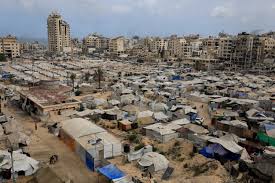
Since the beginning of the war, more than 30,000 Palestinians—many of them women and children—have reportedly been killed, with over 70,000 injured. Hospitals have been bombed, refugee camps shelled, and water systems destroyed.
Now, with aid convoys under fire, even the remaining lifelines for Gaza’s population are in jeopardy. UN officials have warned that famine is imminent in parts of the enclave.
“Any further obstruction or attack on humanitarian aid risks turning this crisis into a genocide by starvation,” warned Jan Egeland, head of the Norwegian Refugee Council.
Global Response Grows Sharper
Protests, Diplomatic Pressure, and Potential Legal Action
The Pope’s condemnation has added to a growing international backlash. Protests erupted in European capitals and several Latin American countries over the weekend, demanding an immediate ceasefire and full humanitarian access to Gaza.
Human rights groups are now urging the International Criminal Court (ICC) to investigate whether the repeated attacks on aid lines constitute war crimes. “This pattern cannot be ignored. There must be accountability,” said Kenneth Roth, former executive director of Human Rights Watch.
Meanwhile, key U.S. allies such as France, Spain, and Ireland have begun to express discomfort with Israel’s actions, though none have yet threatened formal sanctions or arms embargoes.
Ellen DeGeneres Cites Trump as Reason for UK Move
“I Needed to Leave the Chaos”
In a separate development making headlines, television personality Ellen DeGeneres confirmed in an interview that she has moved to the UK—citing Donald Trump’s political return as her primary reason.
“After everything we went through and seeing him make a comeback—it was too much,” she said. “I needed to leave the chaos behind.”
While her comments are tangential to the Gaza crisis, they underscore a global fatigue with American political volatility—volatility that, in many cases, enables or emboldens allied governments, including Israel, to act with impunity.
The World Watches as Gaza Starves
The image of starving civilians gunned down while waiting for food is now etched into the global conscience. With the Pope’s rebuke, international pressure may grow—but whether that translates into action remains to be seen.
For the people of Gaza, time is running out. And as humanitarian corridors become killing fields, the question is no longer whether the war will end soon—but how many more must die before it does.