A Historic Judgment: Russia Found Guilty of Shooting Down MH17
In a damning and long-awaited verdict, the European Court of Human Rights (ECHR) has ruled that the Russian government is legally responsible for the downing of Malaysia Airlines Flight MH17 in July 2014. The Boeing 777, en route from Amsterdam to Kuala Lumpur, was brought down by a Russian-supplied Buk missile over eastern Ukraine—killing all 298 passengers and crew aboard.
Victims hailed from 17 nations, including 198 Dutch citizens, 43 Malaysians, 38 Australians, and 10 Britons. The decision, delivered in Strasbourg on Wednesday, marks a seismic moment in the international pursuit of accountability for Russian military actions beyond its borders.
“Russia is responsible for killing my son,” said Thomas Schansman, father of 18-year-old Quinn Schansman, who perished on the flight. “They never told the truth. Today, that changes.”
A 501-Page Indictment: ECHR’s Unprecedented Ruling
Russia Blamed for “Manifestly Unlawful” Conduct
Court President Mattias Guyomar stated that Russian forces, alongside Moscow-backed separatists in Donbas, were directly implicated in “manifestly unlawful” military action. The court accepted evidence from the Dutch government showing that a Russian Buk-Telar missile system was used to fire at MH17—likely under the mistaken assumption it was a military aircraft.
Although the court did not rule on the identity of the individual who launched the missile, it emphasized Russia’s overarching responsibility for the acts of its military and the separatists it supported.
“No measures were taken by Russia to identify military targets accurately,” the ruling read, citing violations of core international humanitarian principles including distinction and precaution.
Russia’s Denial Adds to Legal Violations
Russia’s refusal to participate in the case further compounded its culpability, the judges noted. The ECHR found that Moscow’s lack of cooperation, combined with its failure to conduct any meaningful investigation into the incident, “significantly aggravated the suffering” of victims’ families.
Kremlin Dismisses Verdict, But Global Pressure Builds
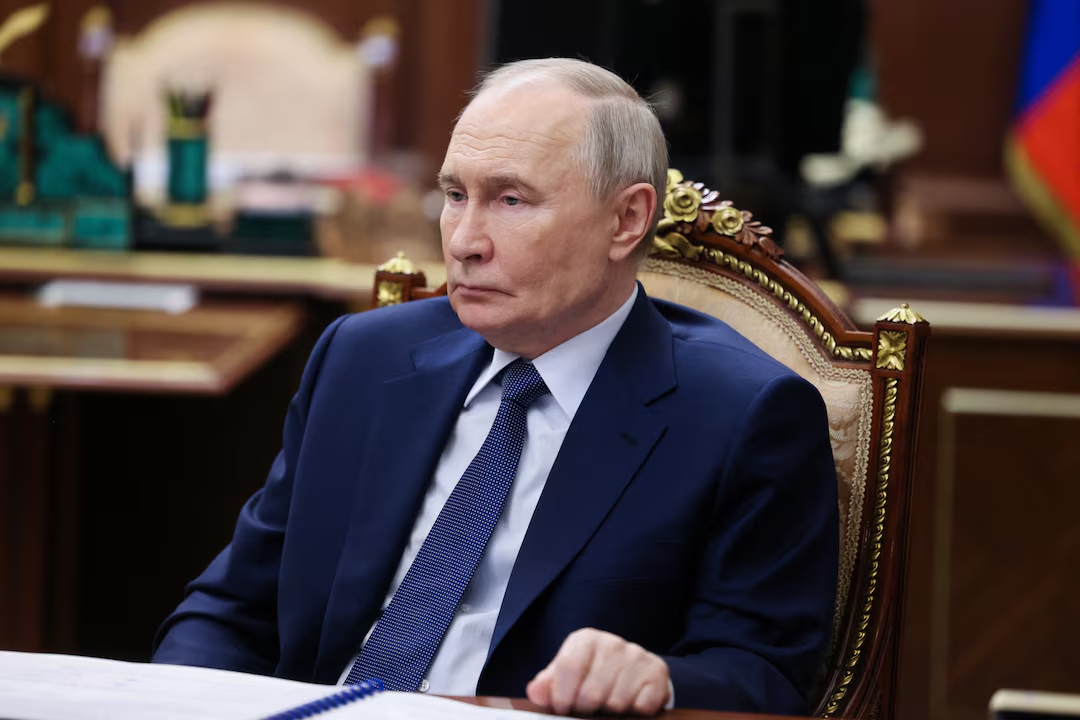
Predictably, the Kremlin dismissed the ECHR ruling outright. “We won’t abide by it, we consider it void,” said Dmitry Peskov, a spokesperson for President Vladimir Putin.
Yet, the court’s decision is likely to pile further international legal pressure on Russia, which has already been condemned by the UN’s aviation agency and held partially liable in prior legal proceedings in The Hague.
While Russia was expelled from the Council of Europe in 2022 following its full-scale invasion of Ukraine, the ECHR retains jurisdiction over actions committed before that date—including the MH17 case.
“This is a symbolic but crucial victory,” said Ukrainian officials in a statement. “It’s a powerful legal acknowledgment that Russia not only killed our citizens, but lied about it for a decade.”
Financial Compensation and Accountability Still Looming
Although the ECHR has not yet ruled on financial damages, the likelihood of Russia paying any compensation appears slim. Nevertheless, legal experts suggest the ruling may influence future asset seizures, sanctions, or international settlements.
The Strasbourg ruling is also distinct from the 2022 Dutch criminal court verdict, which found two Russians and a Ukrainian guilty in absentia for their roles in the MH17 downing and sentenced them to life imprisonment.
What This Means for Global Aviation and War Crime Law
The case sets a precedent for how civilian air disasters in war zones are litigated under human rights frameworks. Experts believe this could open the door for broader international accountability mechanisms—especially for states using proxy militias to obscure their battlefield responsibility.
The verdict also underscores a growing global appetite for using legal institutions to hold the Kremlin accountable for its actions—not only in Ukraine, but worldwide.
The Families Speak: Justice, Eleven Years Later
For the families of MH17 victims, the ruling is more than symbolic. It validates their relentless fight to uncover the truth and force Russia to face international judgment, even in absentia.
“We never asked for revenge. We asked for responsibility,” said one Dutch mother at a press briefing. “Today we got it.”
Legal Isolation of Russia Deepens
This decision adds another layer to Moscow’s legal isolation, even as it continues its aggression in Ukraine. With mounting cases before international courts, including potential charges of genocide, Russia faces an increasingly hostile judicial environment that could one day lead to real diplomatic and economic consequences.
The European Court of Human Rights may not have the power to enforce reparations, but it now stands as a loud, global megaphone—calling out impunity in black and white.