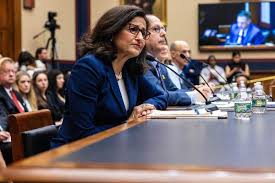
At a politically charged House hearing, top university leaders from UC Berkeley, Georgetown, and the City University of New York (CUNY) pushed back against Republican claims that their campuses have become hotbeds of unchecked antisemitism. They defended their institutions’ actions while reaffirming a delicate balance: safeguarding free speech while confronting hate.
The testimony marks the ninth high-profile congressional inquiry into campus antisemitism since the Hamas attacks on Israel in October 2023, which triggered global outrage, a deadly Israeli bombing campaign in Gaza, and a wave of student protests across American universities.
House Republicans Escalate Scrutiny Over Antisemitism on Campus
UC Berkeley, Georgetown, and CUNY in the Hot Seat
The House Education and Workforce Committee, led by Republicans, called the hearing to question how three major academic institutions have handled accusations of antisemitic incidents and speech. Representatives pressed each university on whether they had taken decisive disciplinary action, dismissed problematic faculty, or addressed inflammatory protests.
Rich Lyons, Chancellor of the University of California, Berkeley, faced direct challenges over student-led Gaza demonstrations, while Félix Matos Rodríguez of CUNY was grilled over a law professor’s work defending a Palestinian activist. Georgetown’s interim president, Robert Groves, fielded questions about protest policies and his university’s interfaith programming.
The central charge: that these universities have failed to clamp down on antisemitism, hiding behind free speech protections and permitting toxic campus climates.
Universities Push Back: Free Speech Is Not Hate Speech
H3: Lyons Stands Firm on First Amendment Protections
In a calm but firm tone, UC Berkeley’s Rich Lyons told the committee that support for Palestinians is not inherently antisemitic, and warned against conflating political speech with hate speech. “As a public institution, Berkeley has a solemn obligation to protect the quintessential American value of free speech,” he said. “This does not prevent us from confronting harassment and discrimination.”
Lyons also acknowledged that antisemitism exists at Berkeley but added that it must be tackled without undermining free expression. “We have more work to do,” he admitted, pledging to balance student safety with constitutional obligations.
Georgetown Cites Jesuit Values of Dialogue
Robert Groves, representing Georgetown University, emphasized the school’s commitment to hosting a range of voices. “We’ve hosted IDF soldiers, families of Israelis and Palestinians, and even relatives of U.S. hostages held in Gaza,” he explained. Georgetown, he noted, has not experienced encampments or physical violence during recent unrest—an achievement he attributed to clear behavioral guidelines and a culture of respectful dialogue.
GOP Questions University Integrity, Threatens Oversight
Stefanik, Walberg, and Fine Demand Accountability
Republican lawmakers, including Elise Stefanik, Tim Walberg, and Randy Fine, were unrelenting in their questioning. Stefanik grilled Matos Rodríguez over a professor who defended Mahmoud Khalil, a Palestinian activist the Trump administration had attempted to deport. “Should this professor be fired?” she asked.
Rodríguez didn’t answer directly but reiterated CUNY’s zero-tolerance stance on antisemitism, asserting that any rule-breaking student or employee would face internal investigation.
Walberg, the committee chair, warned: “Universities can choose to hire antisemitic faculty, accept foreign funding, and ignore antisemitic behavior—but they do so at their own risk.”
Democrats Decry ‘Kangaroo Court’ Tactics
Takano Accuses Republicans of Political Theater
Not all lawmakers were aligned on the hearing’s purpose. California Democrat Mark Takano lambasted Republicans for using the platform to generate headlines rather than improve safety for Jewish students.
“They have turned this hearing room into a kangaroo court… making public theater out of legitimate pain,” he said.
Democrats also called out the Republican hypocrisy for slashing the Education Department’s civil rights division, which is responsible for investigating campus antisemitism and broader discrimination complaints.
Protests Interrupt Hearing as Emotions Run High
Pro-Palestinian Activists Ejected by Capitol Police
Adding to the tension, protesters repeatedly interrupted the hearing, shouting pro-Palestinian slogans before being escorted out by Capitol Police. Their presence underscored the charged atmosphere surrounding college campuses since the Gaza war erupted.
The protests, combined with mounting student unrest and faculty pushback, have created a complex crisis for university leaders who are trying to navigate polarized political climates, rising campus activism, and mounting federal pressure.
The Political Stakes for Universities—and the Nation
Fallout from Previous Hearings Still Reverberates
This isn’t the first time university leaders have faced congressional grilling over antisemitism. In late 2023, presidents of Harvard and the University of Pennsylvania resigned after their equivocal answers on antisemitism during similar hearings drew fierce backlash.
For Berkeley’s Lyons—now in his second year as chancellor—the risks are real. University leaders are now operating under a national microscope, with every word parsed for signs of either cowardice or overreach.
Managing Reputational Risk in a Hyper-Political Climate
University leaders today face a situation that’s strikingly familiar to CEOs navigating stakeholder conflict: high public visibility, polarized pressure groups, and the need to uphold mission-driven values without alienating key constituencies.
The lessons?
-
Anticipate flashpoints: In moments of cultural tension, prepare messaging in advance.
-
Defend core values, but show willingness to evolve policy.
-
Balance transparency with discretion when under federal or media scrutiny.
Institutions like Berkeley and Georgetown must now rebuild trust simultaneously with students, donors, lawmakers, and the public—a challenge familiar to any C-suite executive managing brand integrity under fire.
As political lines harden over issues of identity, speech, and power, the battleground increasingly shifts to American universities. What played out in the House chamber on Tuesday was more than a hearing—it was a referendum on the future of academic freedom, and a cautionary tale for institutional leaders navigating ideological minefields in real time.